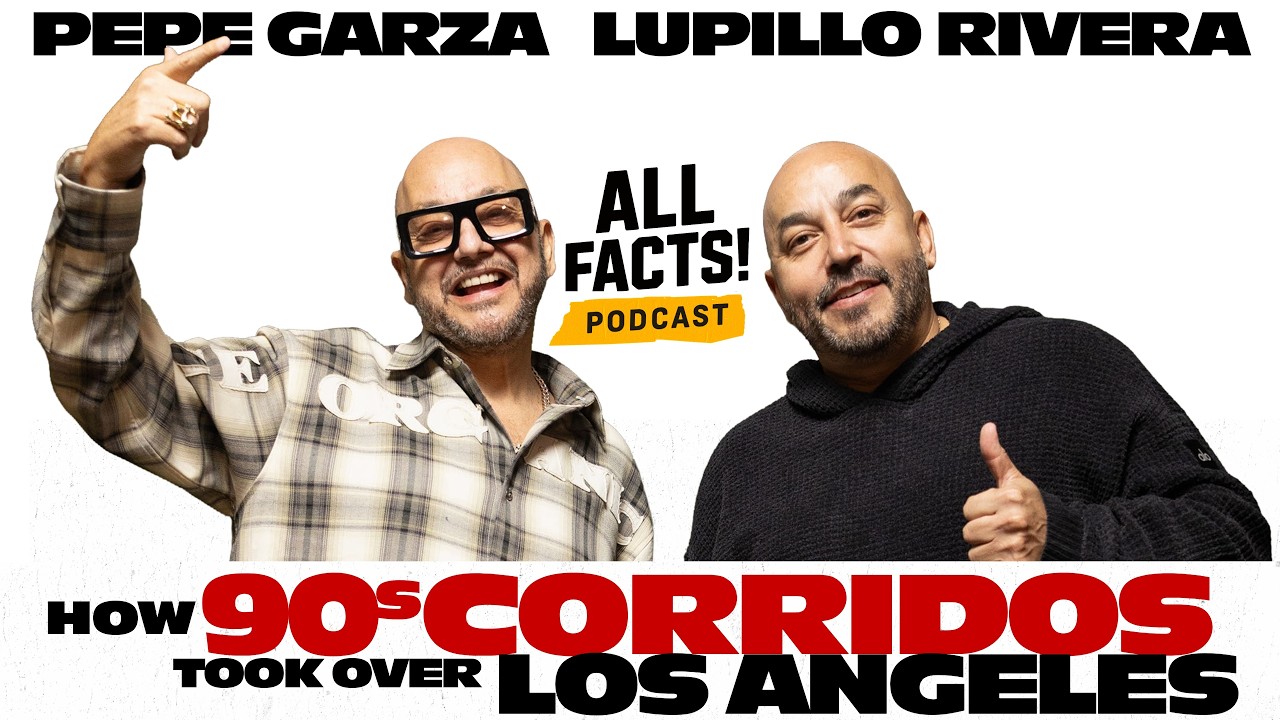
The short version: In the 90s, no radio station in Los Angeles would play corridos, so Lupillo Rivera sold them on cassette at swap meets. Then a program director named Pepe Garza started walking into the discotecas that sold those tapes and asking which ones were moving. On the newest episode of All Facts!, the two of them tell how that turned into a movement, and how it led to what Garza now calls "música mexicana internacional." Rivera is taking that era back on the road with the 90s Corridos Tour, which closes at Pico Rivera Sports Arena on November 22.
Show: All Facts! · Guests: Lupillo Rivera and Pepe Garza · Length: 1 hr 5 min · Watch: full episode below or on YouTube
When Pepe Garza first came to Los Angeles, he spent about eight months in a radio office that looked out on a golf course, playing the same music every other station played: Juan Gabriel, Vicente Fernández, Ana Gabriel, Alejandro Fernández. He was told that was the only thing that worked in LA.
"Yo no sabía que había un mundo diferente," he says (I didn't know there was a different world). In Guadalajara he used to drive around and listen to what people were playing in the street, or go to small dance halls to see who was drawing a crowd. In LA, he says, the hard part was finding where the people actually were.
That other world was the one Lupillo Rivera was working in. "No había radio todavía que tocara corridos," he says (there was no radio yet that played corridos). He and the other acts on his father's label, Cintas Acuario, were writing what he calls the hardcore corrido, the underground music of its day, and selling it themselves: "vendíamos cassettes y vendíamos cosas en los swap meets."
Then the songs started showing up on La Qué Buena. Rivera remembers wondering who had taken his cassettes to the station. It turned out Garza was going to the discotecas where the tapes were sold, asking the women at the counter which ones were selling, and taking those back to program on the air. "Pero era él el que decidía," Rivera says (it was him who decided).
Garza admits he wasn't sure about Rivera at first. Most of the artists who were working at the time sang in the style of Chalino Sánchez, like Jorge Gamboa and Los de la Sierra, and Rivera sounded different. "Se me hace que eso no pega," he remembers thinking (I don't think this is going to hit).
It did. The songs broke first on the small local stations around LA, and then La Qué Buena took them wide. Garza jokes that Rivera made shaved heads the style, and that he shaved his own head after meeting him.
For Garza, the bigger story was what it did for the city. People in Los Angeles, he says, started feeling proud of Lupe, of Jenni, and of groups from their own neighborhoods. In his words, people would say, "estos vatos están en el radio" (these guys are on the radio).
Not everyone liked the change. Garza says the big labels, Fonovisa, Sony and EMI, didn't understand why he was playing the music of Pedro Rivera, Lupillo's father. Some offered to buy advertising if he would be more open to their artists. His answer was that other stations already played those artists, and his was a small station playing something else.
Eventually, he says, the numbers and the sales settled it. The station's owner told him: "Tú haz lo que tú quieras" (do whatever you want).
One of Rivera's biggest songs started with a gift from his mother. She gave him a Javier Solís record and wanted him to record a drinking song from it. He picked "Despreciado" from the same record instead, recorded it in Sinaloa, and put it out first.
He also had to cut it more than once: with banda, and again with norteño for Texas. Some promoters wanted a pop version to get it onto certain stations. He says he never recorded one.
Both men describe how little respect regional Mexican music got from the Miami-based Spanish-language industry. Garza says he couldn't accept that Rivera could sell a million records while artists from other genres got more promotion and the best hotels. Rivera remembers Sony telling him his sales were paying for other artists' videos, and asking why, then, they put him almost alone on the stage at the awards.
So when La Qué Buena held its first awards show, and limousines had been rented for everyone, Rivera showed up in a Bentley. He wanted the Miami media to ask why a corrido singer was driving one. When he was booked on Don Francisco's show, he insisted on singing live with his own group and paying the costs himself, even though the show used playback. The only thing they asked of him, he says, was not to wear snakeskin.
"Mi jale siempre fue tratar de representar a la gente mexicana," Rivera says (my job was always to represent Mexican people). He wanted to show that Mexicans in the U.S. were more than dishwashers, hotel cleaners and cooks, that they could build and earn on their own.
Garza started in radio in 1985 as a board operator and began writing songs around the same time. Today he's known as one of the people who helped launch Jenni Rivera, Lupillo Rivera, Valentín Elizalde and Espinoza Paz, and as the creator of the Premios de la Radio. Asked how he knew El Fantasma would hit before most people had heard of him, he says: "Estoy viendo muy para abajo donde la gente todavía no está" (I'm looking way down, where people aren't yet).
He has watched every wave since the 90s. He credits Gerardo Ortiz's corridos progresivos and Natanael Cano's corridos tumbados with changing the genre each time, and says those styles took regional Mexican music past the "regional" label: "Ya es música mexicana internacional." He says he admires a comeback more than a hit, and points to Fuerza Regida, which is now booked for ten dates at Mexico City's Palacio de los Deportes.
The young crowd comes up again and again. Garza says he sees young people online driving 90s trucks and dressing like it, and wonders how they know all of it. To him, the 90s corridos built a full lifestyle of clothes, trucks and discotecas that doesn't really exist today. One of the hosts remembers Sundays on Pacific Boulevard in Huntington Park when that scene was at its height.
Rivera, for his part, says he still doesn't understand social media: "My kids are the ones that run everything." He thinks fans don't need artists dancing on TikTok, just photos and videos.
The episode doubles as a look at the 90s Corridos Tour. When the tour started, Rivera says, he held a meeting with the other artists at his house and told them that if they were charging 100 dollars to sing, he wanted the tour to get them to 1,000. On this tour, he says, he holds back a little on stage so the other artists get their moments.
Garza's one-line description of Rivera is "rey del escenario" (king of the stage). He remembers telling Rivera, during a hard stretch, that he should retire. Rivera told him he never would, and Garza says he's better now than ever. On why the tour works, Garza says: "Los artistas disfrutan mucho del escenario y cuando el artista está disfrutando la gente conecta mucho" (the artists really enjoy the stage, and when the artist is enjoying it, the people connect).
The November 22 show at Pico Rivera Sports Arena lists Lupillo Rivera with Rogelio Martínez, Jorge Gamboa, Dueto Voces del Rancho, El Chalinillo, Leonel El Ranchero, El Narquillo, El Halcón de la Sierra Jr. and DJ Malechin. Tickets are linked from the tour's official page.
The music Rivera and Garza pushed in the 90s came out of Mexican American LA: swap meets, small stations and backyard parties, built by people who grew up between two countries. Thirty years later the same lane, now called corridos tumbados and música mexicana, sells out arenas in Mexico City and tours far beyond LA. This conversation is a reminder that it started with a few people willing to bet on a sound the industry didn't want yet.
Pepe Garza is a Mexican radio programmer and songwriter. As program director at La Qué Buena in Los Angeles, he put 90s corridos on the air and helped launch artists including Jenni Rivera, Lupillo Rivera, Valentín Elizalde and Espinoza Paz. He also created the Premios de la Radio.
The tour closes on November 22, 2026, at Pico Rivera Sports Arena in Pico Rivera, California. Tickets are linked from the tour's official page.
The Pico Rivera show lists Lupillo Rivera, Rogelio Martínez, Jorge Gamboa, Dueto Voces del Rancho, El Chalinillo, Leonel El Ranchero, El Narquillo, El Halcón de la Sierra Jr. and DJ Malechin.
The full episode is embedded at the top of this page and is on The Foo Community's YouTube channel.
For more stories, read our piece on Jimmy Humilde and Rancho Humilde, and the rest of our music and culture stories.
Get the stories first: join the Cult Media list for the week's music and culture news and new episodes. Sign up here.